Profound vs AirOps (2026): Intelligence vs Execution
Two different tools. Two different problems. Includes a head-to-head on query fan-out tracking . Here's how to know which one you actually need.
Profound and AirOps keep showing up in the same "best AEO tools" lists. And I get why. Both track how your brand appears in ChatGPT, Perplexity, Google AI Overviews and other answer engines.
But they're not the same type of tool. Not even close.
Profound is an intelligence platform. It tells you where you stand, what people ask, what gets cited, and how AI perceives your brand. It's the deepest monitoring tool in the category.
AirOps is a content execution platform. It helps you produce, refresh, and publish the content that actually gets you cited. It added a visibility layer on top. But the engine underneath is built for shipping pages.
Think of it this way. Profound answers "what's happening in AI search for my brand?" AirOps answers "how do I produce 50 articles this month that AI will actually cite?"
Quick answer: who should pick which
Pick Profound if your bottleneck is intelligence. You don't know where your brand stands in AI search. You don't know what people are asking. You need prompt volume data, query fanout analysis, and deep citation tracking across 10+ AI engines. You have a team that can take insights and turn them into content themselves.
Pick AirOps if your bottleneck is execution. You already know what to write but can't produce it fast enough. You need bulk content creation, automated refreshes, CMS publishing, and brand voice governance at scale. You want one platform that monitors and ships.
Use both if you have the budget. Profound feeds the strategy. AirOps runs the production line. Several enterprise teams already do this.
Company and pricing
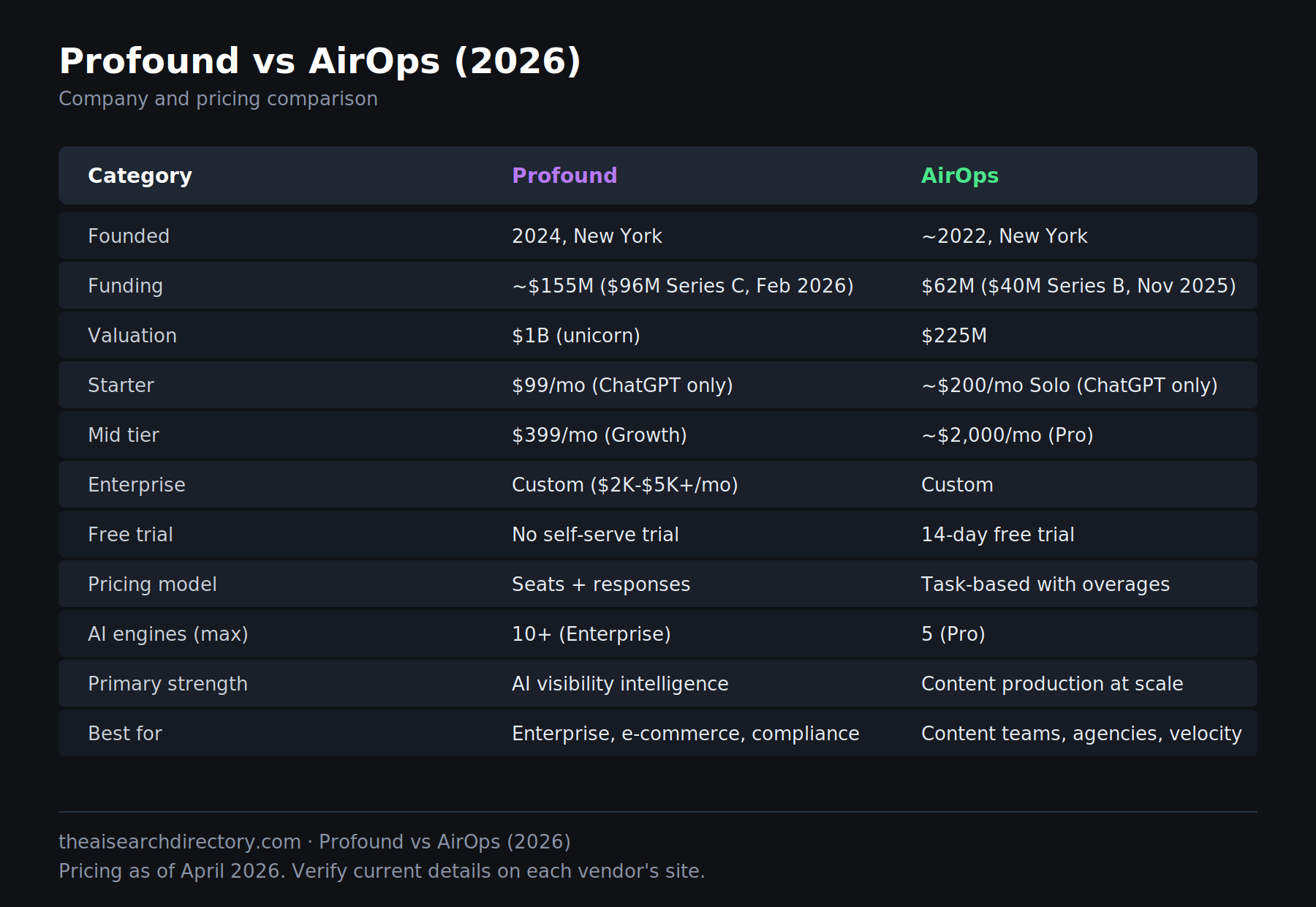 One thing jumps out here. Both tools have a gap in the middle.
Profound's Starter at $99 is too thin for real work (ChatGPT only, 50 prompts). The meaningful plan is Growth at $399. But then Enterprise jumps to $2,000+. That middle gap is where most mid-market teams get stuck.
AirOps has the same problem in reverse. Solo at $200 is ChatGPT only. Pro jumps to $2,000. And the task-based pricing means heavy usage can push costs higher than the headline number. Solo overages run $0.025 per task. That adds up fast when you're running bulk refreshes across hundreds of pages.
What Profound does well
The deepest AI visibility data in the category
This is where Profound has no real competitor. Not AirOps. Not Peec AI. Not anyone else right now.
The core module is Answer Engine Insights. It tracks brand mentions, share of voice, sentiment, citations, competitor benchmarking, and average position across up to 10 answer engines. ChatGPT, Claude, Perplexity, Google AI Overviews, Google AI Mode, Gemini, Microsoft Copilot, Meta AI, Grok, and DeepSeek.
AirOps tops out at five engines. No Claude, no Meta AI, no Grok, no DeepSeek, no Copilot. If you need broad LLM coverage, Profound wins this outright.
Prompt Volumes
This is Profound's signature feature. And it's genuinely unique.
Prompt Volumes estimates how often specific prompts are being asked inside LLMs. Think of it as keyword research for AI search. Profound says they pull from a database of 400M+ prompts. The data comes from a proprietary panel, not from the LLMs themselves (they don't release this publicly).
Is the data perfect? No. It's extrapolated from a panel. But it's the closest thing the AEO industry has to search volume for AI queries. And when you're deciding what content to prioritize, directional data beats guessing.
AirOps doesn't have anything like this.
Query fanouts
If you've read my piece on fan-out you know this matters. When someone asks ChatGPT a question, the system breaks it into multiple sub-queries before searching. Profound surfaces those sub-queries so you can see what AI is actually looking for.
AirOps added query fanouts to its Insights layer in 2026 too. But Profound had it first and goes deeper on the analysis. I compare both in detail below.
Query Fan-Out Tracking: Profound vs AirOps Head-to-Head
Both tools now surface query fan-out data. But they approach it differently and what you can do with that data afterward differs even more.
Profound had fan-out analysis first. Inside Answer Engine Insights, the Query Fanouts page shows every sub-query an answer engine generates for your tracked prompts, how often each variant appears, and how that behavior shifts over time. The analysis spans up to 10 engines. You can see whether AI is rewording your prompt conservatively or expanding it aggressively, and map content gaps against the full fan-out tree.
AirOps added Query Fan-outs to its Insights layer in 2026. It surfaces the sub-queries AI engines run behind each tracked prompt. The feature does what it says. But the real difference isn't the data — it's what happens next. AirOps routes those fan-out gaps directly into content workflows. You see a missing sub-query, you spin up a Grid, you publish the page. The loop closes inside one platform.
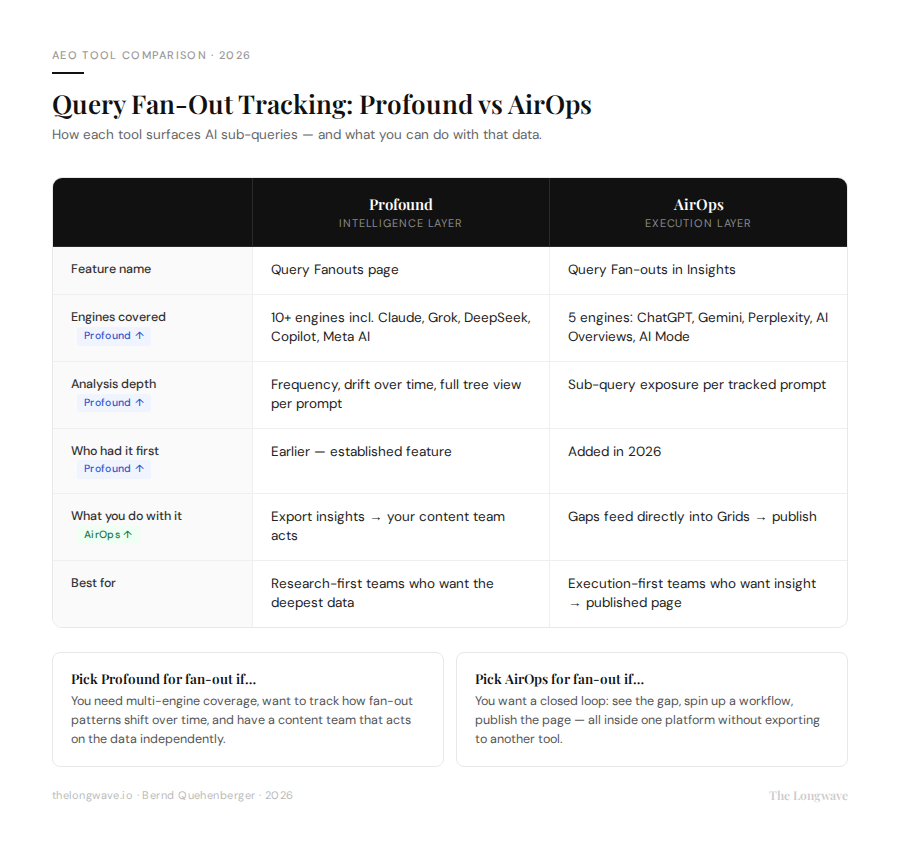 Query Fan-Out Comparison Table.
Agent Analytics
Profound monitors how AI bots crawl your website. Which pages they hit. How often they return. Where crawling is blocked. This is infrastructure-level data that GA4 misses entirely.
Profound integrates with Cloudflare, Vercel, AWS CloudFront, Fastly, Netlify, and WordPress for this. It's a genuinely differentiated feature for technical SEO teams and developers.
AirOps also offers Cloudflare and Vercel bot tracking. But Profound's coverage is broader.
Shopping visibility
For e-commerce brands, Profound tracks how products appear in ChatGPT Shopping. Product images, placement, comparisons, attributes AI assigns to your products. If you're a D2C or Shopify brand, this matters and AirOps doesn't offer it.
Enterprise compliance
SOC 2 Type II. HIPAA (assessed by Sensiba LLP). SSO via SAML and OIDC. If your procurement team cares about security certifications, Profound has them. AirOps offers Enterprise SSO but doesn't publicly tout HIPAA.
Where Profound falls short
No real content execution engine. Profound launched "Profound Agents" for content creation and it's growing fast. But it's still template-driven and newer than AirOps' production workflows. If you need to ship 50+ articles a month with brand voice controls and CMS publishing, Profound Agents isn't there yet.
Pricing is steep and opaque. Profound removed public pricing from its site in early 2026. Everything routes through sales conversations now. Third-party sources peg the real working price at $399/mo minimum, with enterprise landing in the mid-four-figures.
Steep learning curve. Multiple reviewers report feeling overwhelmed by the platform early on. Profound launched "Profound University" to address this. But the onboarding investment is real.
Opportunity insights are thin. Profound surfaces AI-generated optimization recommendations. Reviewers consistently call these generic and underwhelming compared to the depth of the rest of the platform. You'll still want a human strategist interpreting the data.
What AirOps does well
The strongest content production engine in AEO
This is AirOps' real strength. And it's not close.
AirOps was built as a content workflow platform from day one. The AI visibility tracking came later. The production side is mature and battle-tested.
Grids let you run bulk content operations in a spreadsheet-like interface. Research, draft, optimize, publish across 50+ articles in one workflow. Workflows chain together LLM calls, web scraping, SEO research, internal linking, meta generation, and CMS publishing in a drag-and-drop builder. AirOps Studio gives you a full editing environment with a built-in Copilot.
You can publish directly to WordPress, Webflow, Contentful, Strapi, Sanity, and Shopify. No copy-pasting. No manual uploads.
If your problem is "we know what we should write but can't ship it fast enough," this is the tool.
Brand Kit with MCP access
AirOps rebuilt its Brand Kit in 2026. It's now modular: product lines, audiences, regions, content types, tone of voice, writing rules. And it's accessible via MCP from Claude, Cursor, and ChatGPT.
This means your AI agents pull the right brand context for every task automatically. For multi-brand agencies, this is a huge deal.
Profound has a brand hub too. But AirOps' Brand Kit is more mature for production-line content.
Off-site and social workflows
AirOps built workflows for Reddit engagement, LinkedIn, YouTube, and PR-style outreach to high-citation third-party domains. This is the kind of execution layer that pure monitoring tools don't touch.
If you read my upcoming piece on why the AI cited your competitor, off-site presence is one of the biggest factors. AirOps is the only tool that operationalizes this into repeatable workflows.
The $1M Performance Promise
AirOps will refund up to $1,000,000 in eligible spend if their Custom AI Agent doesn't hit defined performance thresholds within six months.
Sounds bold. And it is. But read the fine print.
It's scoped to new Custom Agent customers who go through the Solutions Architect program. You have to follow their best practices guide, connect GA4, stay in good standing, and submit a refund request within 15 days of the evaluation period ending. AirOps reviews the data before approving.
It's a real commercial mechanism. It puts skin in the game. But it's not a blanket money-back guarantee for every customer. Treat it as a high-touch enterprise risk-share.
Integrations that feed content quality
AirOps connects to Gong, Zendesk, HubSpot, and other sources of proprietary customer data. This means your content workflows can pull real customer questions, support tickets, and sales call insights directly into the content creation process.
That's genuinely valuable for making content authoritative. You're not writing from guesswork. You're writing from what customers actually ask.
Where AirOps falls short
Shallower AI visibility data. AirOps tracks five engines. Profound tracks ten. AirOps doesn't include Claude, Meta AI, Grok, DeepSeek, or Microsoft Copilot. If global multi-engine coverage matters to your strategy, AirOps has a gap.
No prompt volume data. AirOps can tell you what prompts you're showing up for. It can't tell you how often those prompts are actually being asked. Profound can.
Task-based pricing is unpredictable. Heavy content production can burn through task allotments fast. Solo overages at $0.025/task and Pro overages at $6 per 1,000 tasks can push the real cost well above the headline price. Monitor your usage.
Learning curve on the workflow side. G2 reviewers mention needing extra time and support to fully use the workflow builder. AirOps addresses this with Academy training and cohort programs. But plan for about a month of setup before you're running at speed. G2's average: 1 month to implement, 8 months to ROI.
Performance at scale. Multiple reviewers report Grids slowing down with 200+ rows running multiple AI columns. If you're doing truly massive bulk operations, test the limits before committing.
The core difference, one more time
This is the simplest way I can put it.
Profound tells you what to write. It shows you the prompts people ask, the fanout queries AI generates, the citation sources that win, the competitors that dominate, and the sentiment around your brand. It's the research and intelligence layer.
AirOps helps you write it. It takes your content strategy (wherever it comes from) and turns it into published pages at scale. With brand voice. With CMS publishing. With off-site distribution. It's the production and execution layer.
Both now claim to do both. Profound added Agents. AirOps added Insights. But the DNA is still clear. Profound's monitoring is deeper. AirOps' execution is more mature.
Who should pick Profound
You're an enterprise brand where AI visibility is a board-level conversation. You need multi-engine, multi-language, multi-region tracking. You're in e-commerce and need ChatGPT Shopping visibility. You want prompt volume data to decide what content to invest in. You have the team to turn insights into action. You need SOC 2 and HIPAA compliance.
Who should pick AirOps
Your bottleneck is content velocity. You need to produce and refresh dozens of pages per month. You want direct CMS publishing without manual uploads. You're a multi-brand agency that needs per-client Brand Kits. You want off-site workflows for Reddit, LinkedIn, and PR outreach. You need a content production system, not just a dashboard.
Who should use both
If you have the budget, the combination covers the gaps. Profound feeds prompt volumes and citation intelligence → AirOps turns those insights into published content at scale.
Several enterprise teams already run this stack. It's not cheap. But if AI visibility is a strategic priority, the Profound intelligence layer plus the AirOps execution layer is the most complete setup in the market right now.
Frequently asked questions
Is AirOps cheaper than Profound? At the entry level, yes. AirOps has a free Insights tier and a $200/mo Solo plan. Profound starts at $99/mo but only covers ChatGPT. At the mid-tier, AirOps Pro at $2,000/mo is more expensive than Profound Growth at $399/mo. But AirOps Pro includes content production. Profound Growth is monitoring only.
Which tool covers more AI engines? Profound. It tracks 10+ engines including Claude, Meta AI, Grok, DeepSeek, and Copilot. AirOps covers five: ChatGPT, Perplexity, Google AI Overviews, Google AI Mode, and Google AI Studio.
Does either tool have prompt volume data? Only Profound. It draws from a proprietary dataset of 400M+ prompts. AirOps does not estimate prompt search volumes.
Can AirOps publish content directly to my CMS? Yes. WordPress, Webflow, Contentful, Strapi, Sanity, and Shopify. Profound Agents can publish to WordPress, Sanity, and Contentful but the integration is newer.
Does either tool track AI bot crawlers on my site? Both do. Profound integrates with Cloudflare, Vercel, AWS CloudFront, Fastly, Netlify, and WordPress. AirOps integrates with Cloudflare and Vercel.
Is the AirOps $1M guarantee real? It's real but narrowly scoped. Only for Custom Agent customers who go through the Solutions Architect program. Multiple eligibility conditions apply. It's a high-touch enterprise risk-share, not a blanket refund policy.
Which tool has better G2 ratings? Both sit at 4.6/5 on G2. Profound has more reviews (140+). AirOps has around 80-120 depending on the page. Both are well-regarded.
Can I start with one and add the other later? Yes. Most teams start with whichever matches their immediate bottleneck: Profound if they need intelligence first, AirOps if they need production first. Adding the second tool later is common.
The bottom line
There's no winner here. Just a better fit for your specific problem.
If you don't know where you stand in AI search, start with Profound. Get the data. Understand the landscape. Then figure out how to act on it.
If you already know what to write but can't ship fast enough, start with AirOps. Get the content engine running. Ship pages. Measure results.
If you can afford both, run them together. Profound for strategy. AirOps for execution.
The bigger decision is the one you already made by reading this far: AI search visibility isn't optional anymore. The tool you pick matters less than the fact that you're picking one.