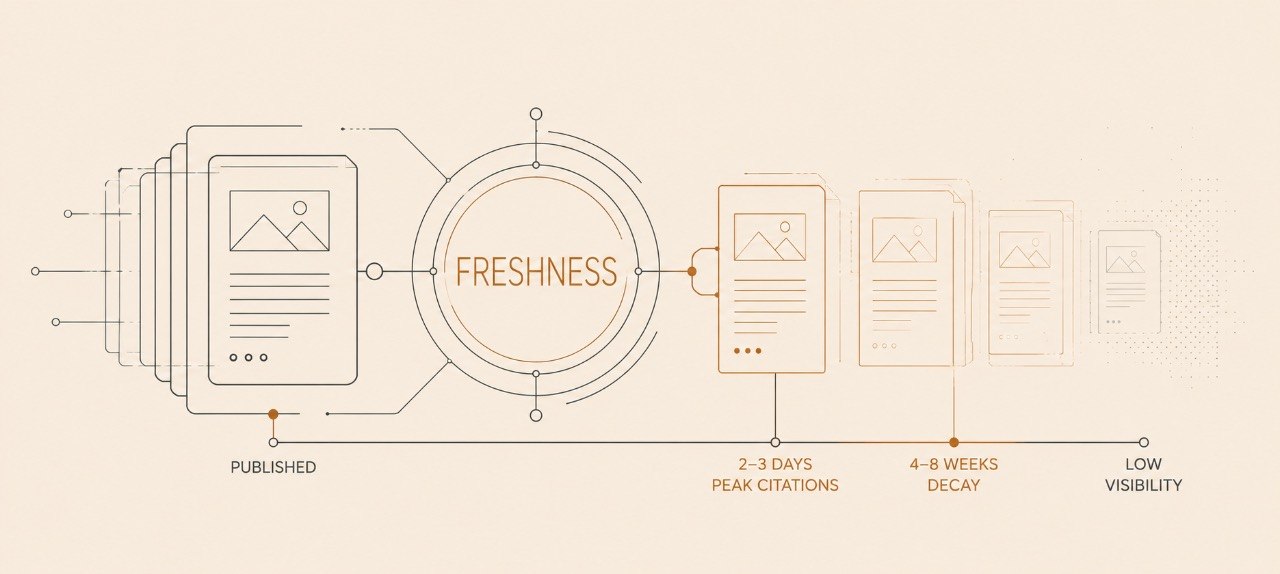
Your Content Has a Shelf Life. But how fast does it expire?
Why your best content is losing citations right now, and what to do about it.
Last time we covered why your competitor gets cited and you don't. Earned mentions, third-party authority, the citation game.
This week is the other side of the coin.
Because even if you nail your structure and build your earned presence, your content can still go invisible because it expires.
And your visibility decays.
Here is everything you have to know about content freshness.
And also what you SHOULDN'T do.
The fastest content decay in search history
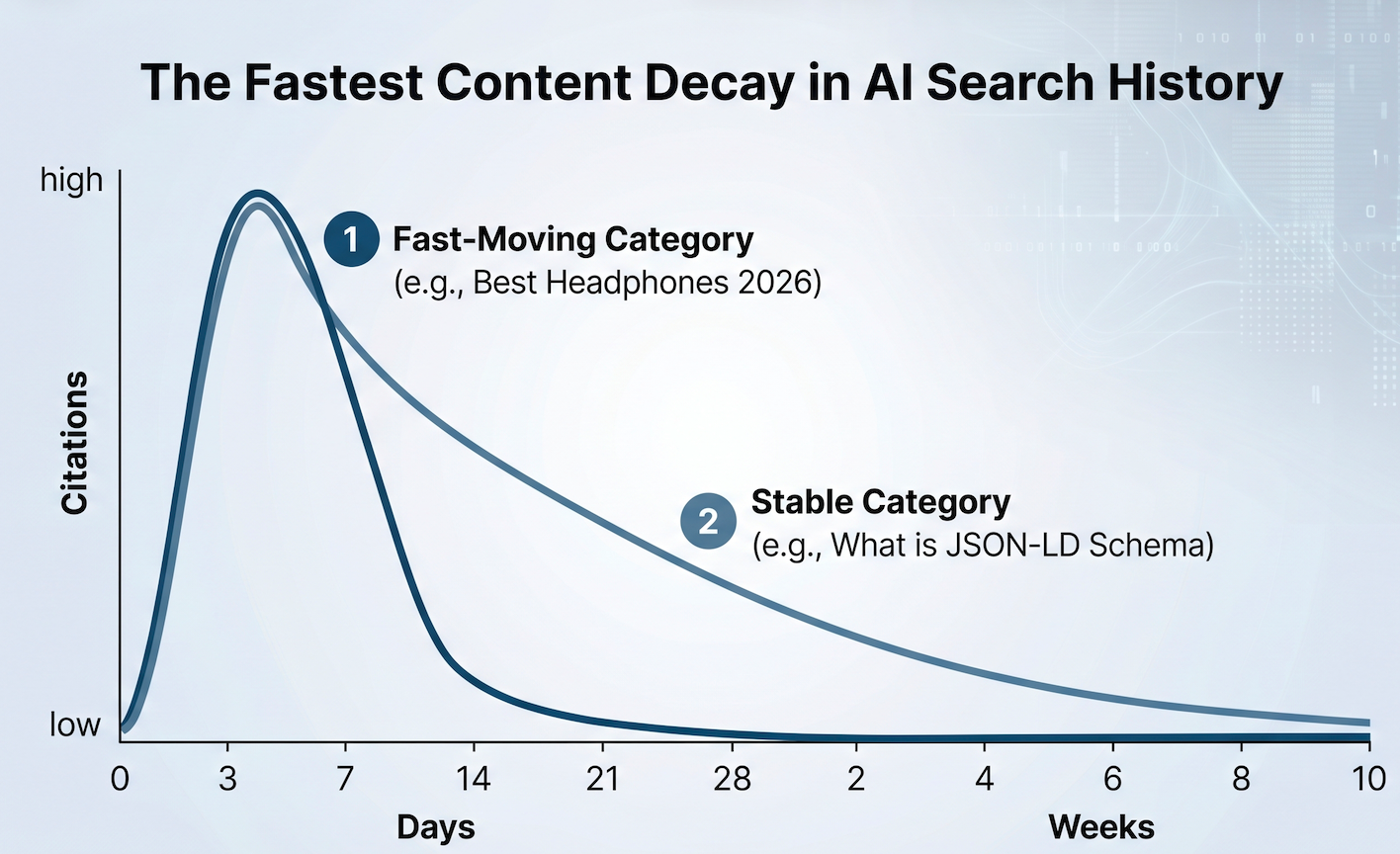
According to Profound's research, when you publish a new piece of content, citations spike within 2-3 days. Then they decay over roughly 4-8 weeks back to a much lower baseline.
The faster your category moves, the shorter the window. For something like "best headphones 2026" the window might be 3 weeks. For something more stable like "what is JSON-LD schema" you might get longer.
This is different from how Google handles freshness. Google will happily cite a 5-year-old page if it's authoritative enough. LLMs won't.
Why LLMs care about freshness more than Google does
There is a structural reason for this.
When you search Google, you are getting a list of pages. You can scan the dates yourself and decide what is still relevant. Old content might rank, but the user can choose to ignore it.
When you ask an LLM, you don't see the source dates. You get one synthesized answer. So the model has to take freshness into account itself. If it cites a 4-year-old article that says "the best CRM in 2022 is X," the user will assume that's still true today. The model knows this, so it weights recent content heavily to avoid surfacing stale information.
The faster the model, the more it cares about freshness. Perplexity especially favors recent content, often citing sources less than a year old.
But there is something you can do about it.
The freshness signals that actually matter
So how do you signal freshness to an LLM?
Three things matter most.
1. The dateModified in your schema.
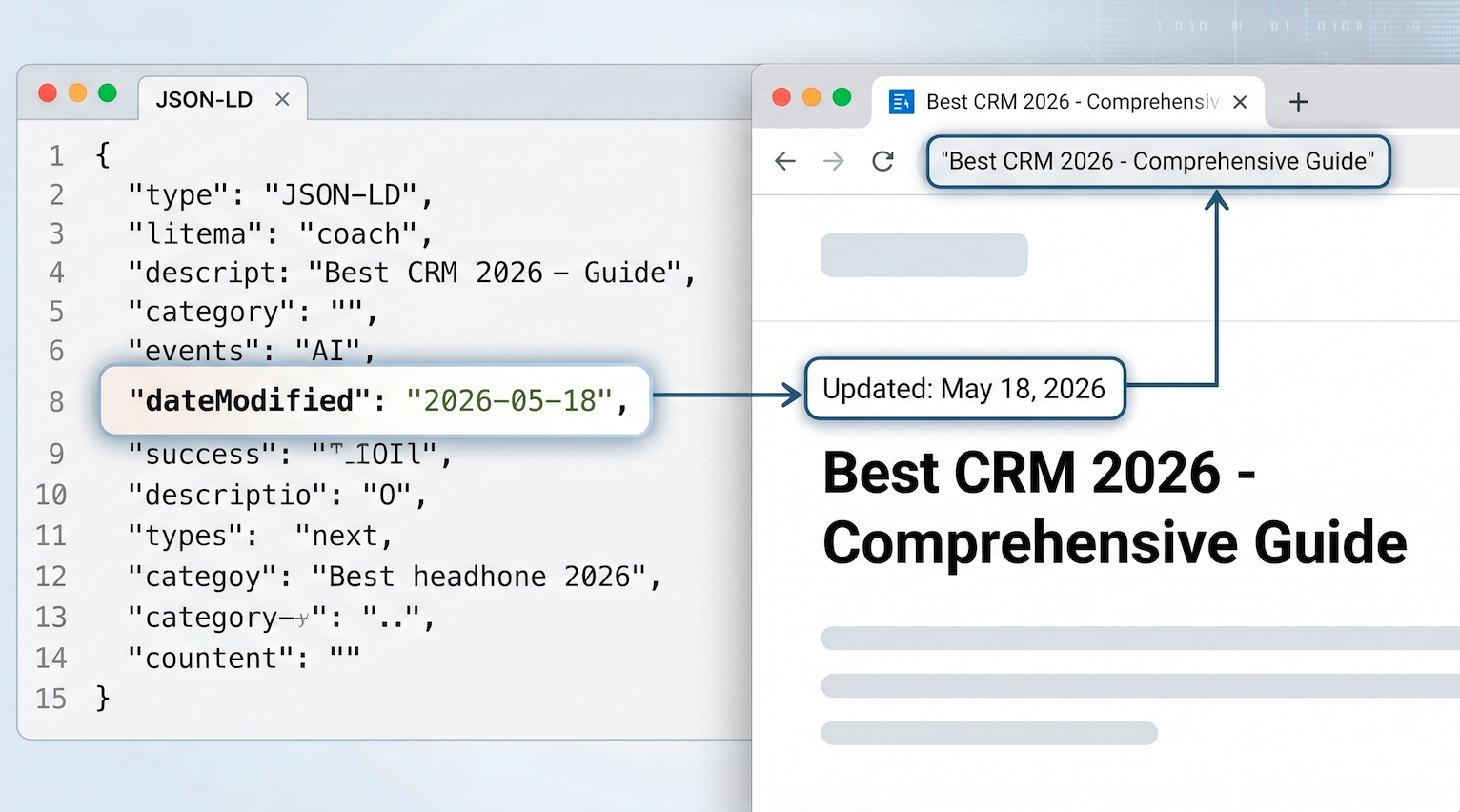
LLMs read structured data and use the dateModified field to assess how recent your content is. If your page hasn't been updated in 18 months and the schema reflects that, the model will deprioritize it. If you update the page and bump the dateModified, the model treats it as fresh again.
Make sure dateModified updates automatically in your CMS when you make meaningful changes.
2. Year strings in your title tag.
Including the current year ("Best CRM 2026") in your title tag has been shown to lift ChatGPT citations by up to around 20%, according to Profound's testing.
Why?
Because when ChatGPT fans out, the sub-queries it runs often include the current year. "Best CRM 2026" matches that fan-out directly. "Best CRM" doesn't.
The aggressive version is putting the year in your URL slug too. That works but creates a redirect headache every January. Title tag only is the safer play.
3. The visible "Updated on" date on the page itself.
A clear "Updated: May 2026" line near the top of your page signals freshness to both the human and the model. Combined with genuinely refreshed content, it's one of the strongest signals you can send.
Don't change the date without changing the content. Update the date and the substance together.
But how often to refresh your content?
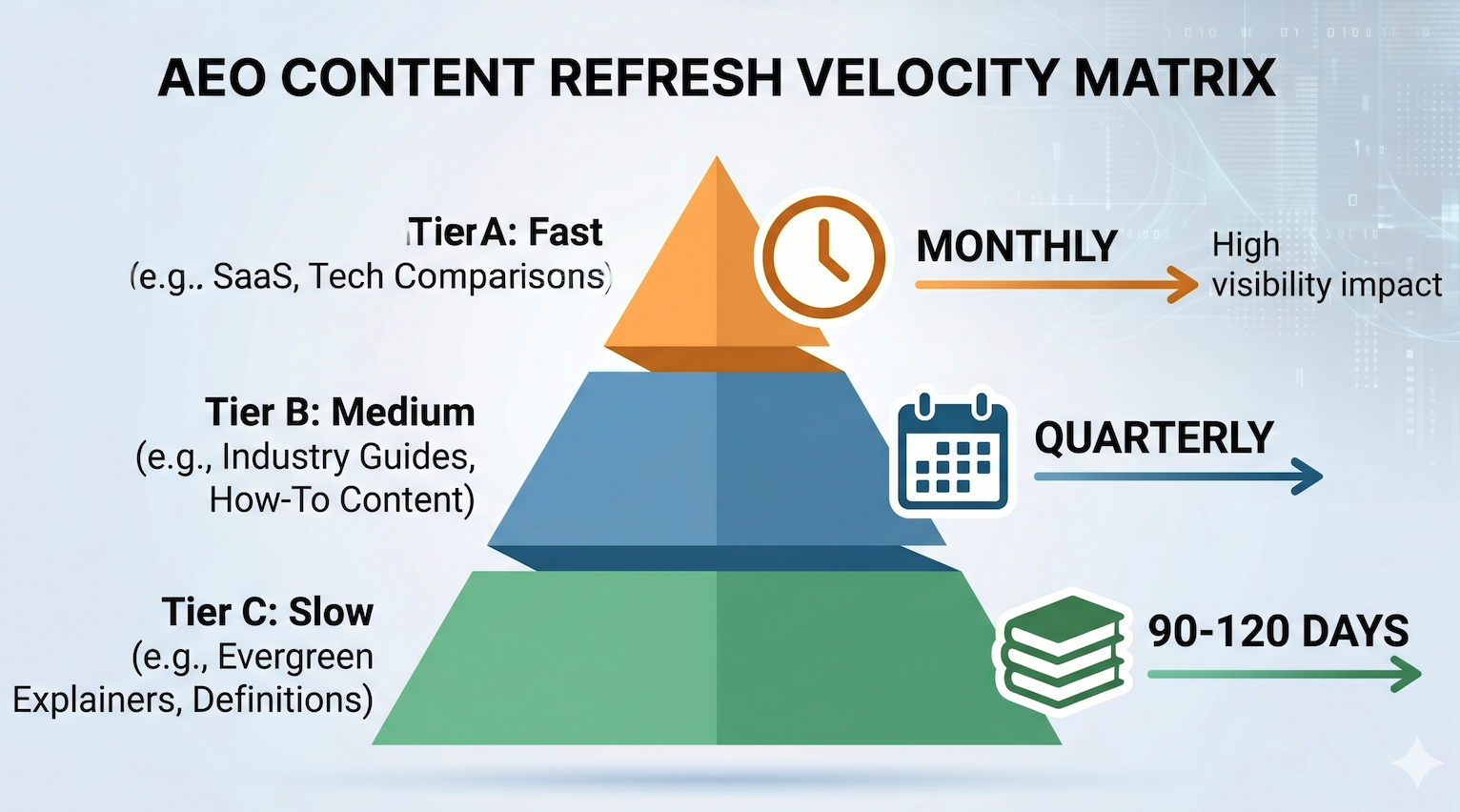
How often should you actually refresh? According to Profound's AEO playbook, this depends on category velocity.
Tier A (fast-moving): refresh monthly. Best X tools, SaaS comparisons, credit cards, anything in tech where pricing, features, and competitors change constantly.
Tier B (medium velocity): refresh quarterly. Industry guides, how-to content, frameworks. Content that doesn't change fundamentally but benefits from new examples and updated stats.
Tier C (slow velocity): refresh every 90-120 days. Evergreen explainers, definitional content. These have longer half-lives but they still decay.
And now something important.
What "refresh" actually means
Don't just change the date, swap a screenshot, and call it done.
A real refresh hits four things:
Re-validate every stat and claim and update what isn't true anymore.
Add new dimensions. New tools, new use cases, new columns in your comparison tables. The model rewards good and complete content.
Bump both the dateModified in schema and the visible date on page.
Add or revise one or two sections. Even small structural additions signal real work, not just a date change.
Then resubmit to Bing Webmaster Tools and Google Search Console so crawlers see the new version before the old citations expire.
The bottom line
In AI search, your content is a depreciating asset. You either invest to maintain it or you watch your citation share decline month by month.
- Pick your top 10 pages.
- Tag them by velocity tier.
- Build a refresh calendar.
- Then actually do it.
That's the difference between teams that compound visibility over time and teams that watch their AEO share quietly erode.
End of Lesson 5. Next week: the page that wins in AI search looks nothing like what ranks in Google.
This Week's Signals
Five things moved this week. All of them matter for how you think about AI search.
Google made it official: AEO is still SEO. Google published its first ever optimization guide for AI search features. The message: stop treating AEO as a separate discipline. For Google's own surfaces, you don't need llms.txt, special schema, or AI-specific rewrites. Just good SEO. Clean crawlability. Unique content that isn't available elsewhere.
Bing explained how AI indexing actually works. A technical post from Microsoft's Bing engineering team made one thing crystal clear: in AI search, a stale fact means a wrong answer. Not just a lower ranking. A wrong answer. The new unit of value isn't your page. It's a discrete, attributable fact with clear provenance. Bing also officially named GEO in its webmaster guidelines for the first time.
Every GPT upgrade concentrates citations in fewer domains. GPT-5.5 cites brand websites 47% of the time. GPT-5.4 cited them 57% of the time. Domains with more than 32K referring domains are 3.5x more likely to be cited. The AI citation world is developing the same winner-takes-most dynamic as page one of Google. The window to break in is narrowing with every model upgrade.
Being cited and being named are not the same thing. AI Mode references sources 76% of the time but only names brands 38% of the time. AI Overviews are better: 85% citations, 61% brand mentions. You need to track both. Your brand could be invisible in answers even if your page is cited.
Google Analytics now shows you which AI sent the traffic. GA4 can now separate visits from ChatGPT, Claude, Gemini, and other AI sources natively. No more guessing. No more third-party workarounds.
The takeaway: Google closed the AEO-vs-SEO debate. Bing raised the bar on content quality. GPT-5.5 tightened the citation gate. If your content isn't fresh, attributed, and authoritative, each model upgrade is quietly making you less visible.
Sources
Email 5 Course Lesson
Profound AEO Playbook — Josh Blyskal (freshness decay data, year string lift, refresh cadence tiers) https://www.youtube.com/watch?v=GgGueQggcfU
Profound: Answer Engine Optimization guide for marketers https://www.tryprofound.com/guides/answer-engine-optimization-aeo-guide-for-marketers-2025
Google AI Search Optimization Guide
Google Search Central Blog: New resource for optimizing https://developers.google.com/search/blog/2026/05/a-new-resource-for-optimizing
Google: Optimizing your website for generative AI features https://developers.google.com/search/docs/fundamentals/ai-optimization-guide
SEJ: Google's New AI Search Guide Calls AEO And GEO 'Still SEO' https://www.searchenginejournal.com/googles-new-ai-search-guide-calls-aeo-and-geo-still-seo/575026/
Bing AI Indexing + Grounding
Bing Blog: Evolving role of the index https://blogs.bing.com/search/May-2026/Evolving-role-of-the-index-From-ranking-pages-to-supporting-answers
Bing Blog: Keeping Trusted Content Visible in an AI-Powered Search World https://blogs.bing.com/search/May-2026/Keeping-Trusted-Content-Visible-in-an-AI-Powered-Search-World
GPT Citation Concentration
Averi.ai: ChatGPT vs Perplexity vs Google AI Mode benchmarks https://www.averi.ai/how-to/chatgpt-vs.-perplexity-vs.-google-ai-mode-the-b2b-saas-citation-benchmarks-report-(2026)
GEO Metrics + Brand Mentions
Search Engine Land: 8 GEO Metrics to Track in 2026 https://searchengineland.com/geo-metrics-to-track-476642 GA4 AI Traffic Attribution
Search Engine Land: Latest posts https://searchengineland.com/google-analytics-ai-assistant-477544